
Silas in the Bible was an important leader in the early Christian church, known for his faith, courage, and dedication to spreading the gospel. His name is closely connected to the New Testament, especially the Book of Acts, where he served alongside the Apostle Paul. Understanding the meaning of Silas in the Bible reveals his important role in Christian history and ministry.
Silas was a prophet, trusted messenger, and missionary who helped spread the teachings of Jesus to new communities. Through his missionary journeys with Paul, Silas in the Bible represents faithful partnership, spiritual strength, and commitment to God’s work. His story offers valuable biblical lessons about faith, perseverance, and serving God with humility.
What Does the Name Silas Mean?

The name most likely comes from an Aramaic form linked to the Hebrew name Saul, which means “asked for.” Some scholars also connect it with Silvanus, a Latin name meaning “of the forest” or “woodland.”
Both meanings fit his story. He was a person “asked for” by the church to carry an important message. He was also a steady, rooted believer who stayed strong in hard places.
| Name Form | Language | Likely Meaning | Where It Appears |
| Silas | Greek/Aramaic | “Asked for” | Acts |
| Silvanus | Latin | “Of the forest” | Paul’s and Peter’s letters |
| Saul (related) | Hebrew | “Asked for” | Old Testament |
Origin and Language
The name belongs to the multilingual world of the first century. Jewish believers often carried both a Hebrew or Aramaic name and a Greek or Latin one.
Luke, the author of Acts, uses the Greek form. Paul and Peter use the Latin form in their letters. Scholars widely agree that both names point to the same man.
Who Is Silas in the Bible?
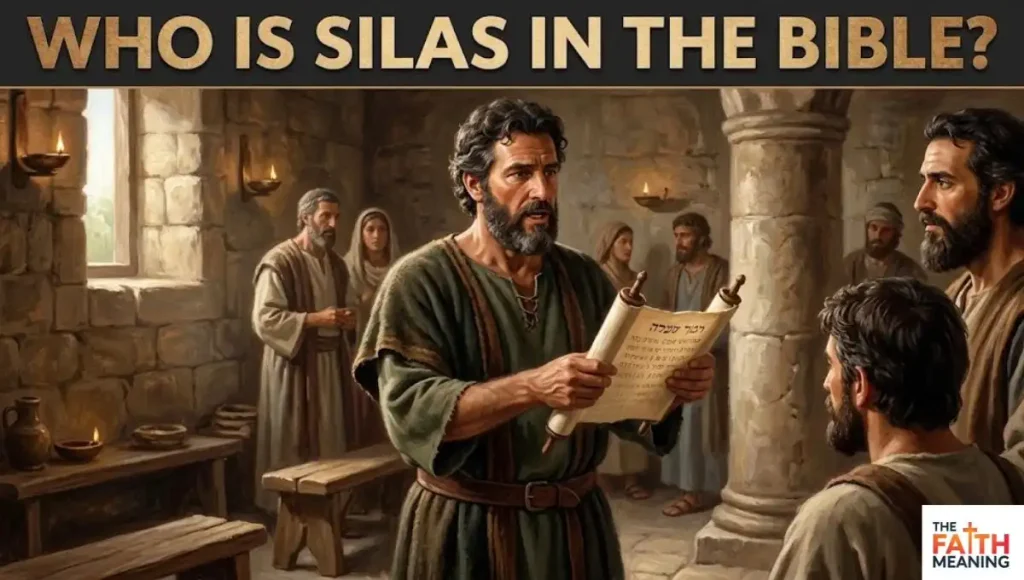
He was a first-century Jewish Christian and a leading member of the Jerusalem church. The New Testament gives us a short but powerful profile:
- A church leader: Acts calls him one of the “leading men among the brothers.”
- A prophet: He encouraged and strengthened believers with his words.
- A Roman citizen: This detail shaped events in Philippi.
- A missionary: He traveled with Paul across Greece and Asia Minor.
- A trusted writer: Peter relied on him to deliver a letter.
Life and Role in Scripture
Chosen in Jerusalem
After the Jerusalem Council, church leaders needed someone reliable to explain their decision to Gentile believers. They chose him and Judas Barsabbas to travel to Antioch with a letter. His wisdom and good reputation made him the right choice.
Imprisoned in Philippi
On Paul’s second journey, he and Paul were beaten and thrown into prison in Philippi. At midnight, they prayed and sang hymns. An earthquake shook the prison doors open, and the jailer and his household came to faith.
Serving in Berea and Corinth
After leaving Thessalonica, the team moved on to Berea. Paul later went ahead while he and Timothy stayed behind to strengthen the new believers. They rejoined Paul in Corinth, where the ministry continued.
Silas and Paul: Their Missionary Journey and Ministry
Their partnership began after Paul and Barnabas parted ways. Paul chose a new companion, and the church sent them out with its blessing.
Here is the route in simple steps:
- Antioch to Syria and Cilicia: They strengthened the existing churches.
- Derbe, Lystra, and Galatia: Timothy joined the team.
- Troas to Philippi: They preached, were jailed, and then freed.
- Thessalonica and Berea: They taught in synagogues and met with both support and opposition.
- Corinth: They helped establish a lasting church.
Their teamwork shows that ministry is rarely a solo effort. Paul’s letters to the Thessalonians even open with greetings from Paul, Silvanus, and Timothy.
Read more: Lily Name Meaning in the Bible: A Symbol of Purity, Beauty, and God’s Care
Biblical Role and Context
His ministry took place in the decades after Jesus’ resurrection. The church was growing fast, and questions about Gentile believers needed careful answers.
He helped bridge two worlds. As a Jerusalem insider, he carried authority with Jewish believers. As a traveling missionary, he helped Gentile communities feel welcomed and informed.
He is also tied to the apostle Peter. In 1 Peter, Peter writes that he composed the letter “by Silvanus,” showing the trust leaders placed in him.
Key Bible Verses About Silas
| Verse | What It Tells Us |
| Acts 15:22 | He was chosen as a leading man in Jerusalem |
| Acts 15:32 | He was a prophet who encouraged believers |
| Acts 15:40 | Paul selected him as a ministry partner |
| Acts 16:25 | He prayed and sang in prison |
| Acts 16:37 | His Roman citizenship is mentioned |
| Acts 17:10 | He ministered in Berea |
| 2 Corinthians 1:19 | He preached Christ alongside Paul and Timothy |
| 1 Peter 5:12 | Peter calls him a faithful brother |
Spiritual Lessons We Can Learn From Silas in the Bible
His story is practical for modern life. These are the key takeaways:
- Faithfulness matters more than fame. He rarely stood in the spotlight, yet the early church depended on him.
- Worship can happen in the dark. Singing in a prison cell shows faith that does not depend on comfort.
- Good partnerships multiply impact. Paul, Timothy, and he worked as a team.
- Wisdom builds trust. Leaders chose him because he was reliable.
- Hardship can open doors. The Philippian jail became the place where a family found faith.
Why Silas Matters in the Bible
He matters because he links major moments in the early church. He appears at the Jerusalem Council, on Paul’s journey, and in Peter’s letter.
His life also reminds us that supporting roles are not small roles. Without trusted helpers, the gospel would not have spread so widely so quickly.
For readers today, his example encourages steady service. You do not need a big platform to make a lasting difference.
Related Names in the Bible
| Name | Connection |
| Silvanus | The Latin form used in the letters |
| Paul | His main ministry partner |
| Timothy | Fellow worker on the second journey |
| Barnabas | Paul’s earlier companion |
| Judas Barsabbas | Traveled with him to Antioch |
| Peter | Used him as a letter bearer |
Frequently Asked Questions
Who was Silas in the Bible?
He was a Jerusalem church leader, prophet, and missionary who traveled with Paul on his second journey.
What does the name Silas mean?
It likely means “asked for,” and it is closely linked to Silvanus, meaning “of the forest.”
Is Silas the same as Silvanus?
Most scholars say yes. Acts use the Greek form, while the letters use the Latin form.
Was he a Roman citizen?
Yes. Acts 16:37 indicates that he and Paul were Roman citizens, which affected how Philippi’s officials responded.
What happened to him and Paul in Philippi?
They were beaten and jailed, then freed by an earthquake. The jailer and his household believed.
Did he write any book of the Bible?
No book carries his name. However, 1 Peter says Peter wrote it with his help.
Why did Paul choose him as a partner?
He had a strong reputation, spiritual maturity, and the church’s full support.
Where can I read about him?
Read Acts 15–18, then 2 Corinthians 1:19, 1 Thessalonians 1:1, and 1 Peter 5:12.
Conclusion
The story of Silas shows how quiet faithfulness can shape history. He carried messages, encouraged believers, and sang through suffering. His name may mean “asked for,” and the early church truly relied on him.
His life also teaches us how to serve well. We can stay steady in trials, work as part of a team, and trust God in dark places. These lessons remain just as relevant today.

Welcome to TheFaithMeaning! I’m Abdul Rehman.
Christian Faith Writer | 5+ Years of Biblical Research | Founder of TheFaithMeaning.com
I share well-researched Bible Name Meanings, Spiritual Meanings, and Biblical insights to help readers discover the deeper meaning of Scripture and grow in their faith.